


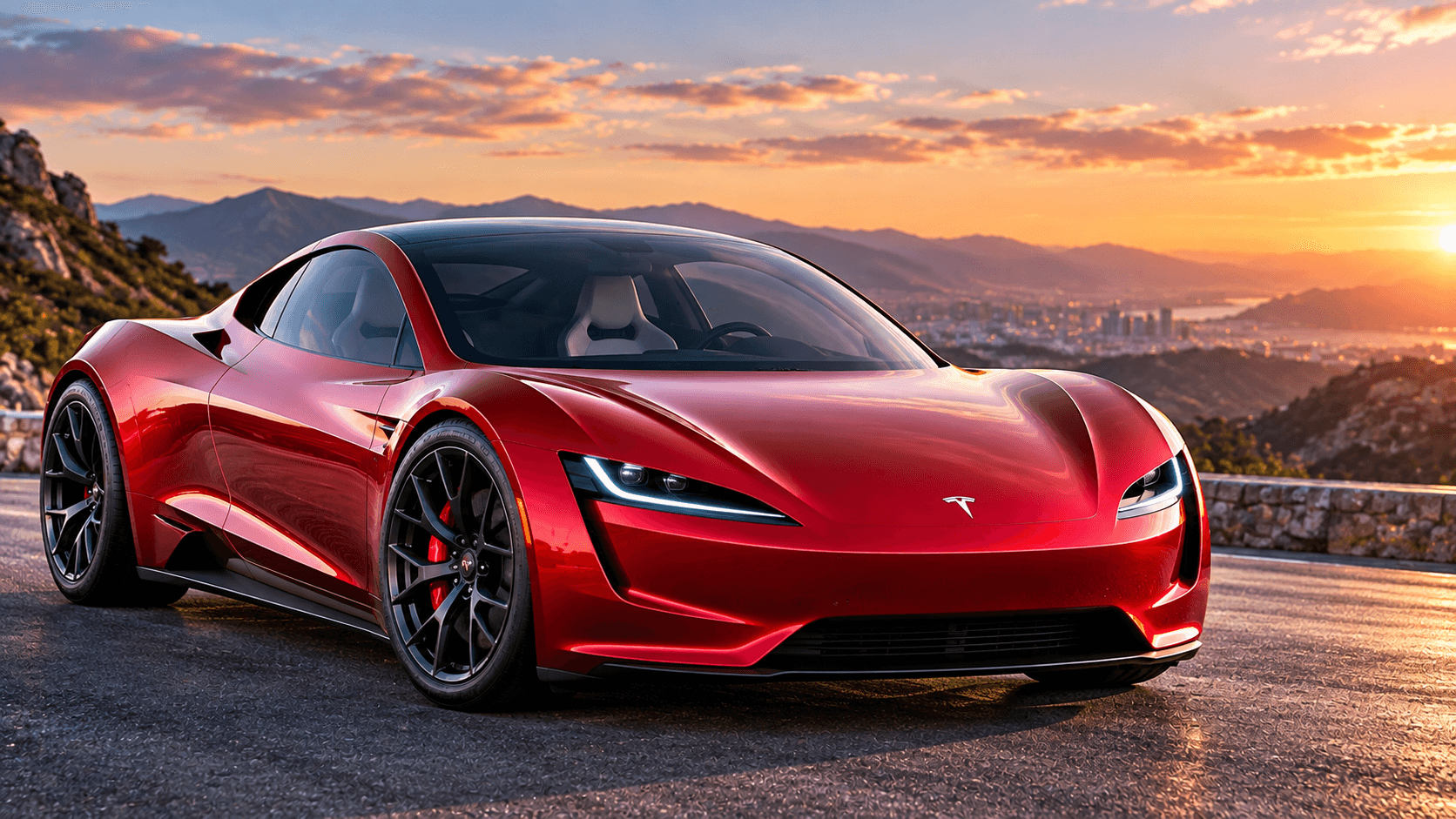
Comprehensive guide to the next-gen Tesla Roadster. Explore claimed 0-60 in 1.9s, 620-mile range, 200 kWh battery, SpaceX thrusters, price, and latest launch updated
Few vehicles in modern automotive history have occupied public imagination quite like the next-generation Tesla Roadster. When Elon Musk drove a sleek red prototype out of a Tesla Semi container in November 2017, the announced figures sounded like science fiction: zero to 60 mph in 1.9 seconds, a top speed exceeding 250 mph (400 km/h), and an unprecedented 620 miles (1,000 km) of driving range. Tesla boldly proclaimed that electric propulsion would render internal-combustion exotics obsolete across every metric.
Yet the journey from jaw-dropping prototype to customer driveways has proven extraordinarily complex. Originally scheduled for deliveries in 2020, the second-generation Roadster has experienced successive delays as Tesla prioritized high-volume vehicles like the Model Y, scaled the Cybertruck, and explored aerospace-derived cold-gas thruster technology alongside SpaceX. As the industry moves through 2026, the vehicle remains an unreleased pre-production model targeted for production in 2028.
This comprehensive technical analysis and buyer's guide breaks down the verified facts behind the Tesla Roadster. We examine the vehicle's development journey, evaluate its tri-motor powertrain and 200 kWh battery claims, compare it against production rivals like the Rimac Nevera and Porsche Taycan Turbo GT, and address what buyers should expect regarding pricing, production timelines, and global availability.
2. Tesla Roadster at a Glance: Verified Specifications
The table below summarizes the technical specifications, performance claims, and commercial status of the next-generation Tesla Roadster based on official Tesla announcements and verified regulatory disclosures:
| Parameter | Official Tesla Claim / Verified Status |
|---|---|
| Vehicle Generation | Tesla Roadster (Second Generation / Next-Gen) |
| Body Style | 2-Door, 2+2 Seater Targa Sports Car with Removable Glass Roof |
| Current Development Status | Pre-production prototype development (Not in commercial production) |
| Customer Deliveries | Deliveries have not commenced; no production units delivered |
| Production Timeline Target | Revised target set for 2028 (subject to engineering finalization) |
| Announced Base Price | $200,000 USD (Base model, subject to final revision) |
| Founders Series Price | $250,000 USD (Limited to first 1,000 reservations; required full upfront payment) |
| Standard Reservation Deposit | $50,000 USD ($5,000 card payment + $45,000 wire transfer) |
| Claimed 0–60 mph Acceleration | 1.9 Seconds (Standard model) | Sub-1.0s claimed with optional SpaceX Thruster Pack |
| Claimed 0–100 mph Acceleration | 4.2 Seconds (Manufacturer prototype claim) |
| Claimed Top Speed | Above 250 mph (400+ km/h, unverified by independent sanctioning bodies) |
| Claimed Driving Range | 620 Miles (1,000 km) on a single charge |
| Battery Pack Capacity | 200 kWh (Structural battery pack design announced) |
| Drivetrain Layout | Tri-Motor All-Wheel Drive (One front motor, two rear motors) |
| Claimed Wheel Torque | 10,000 Nm (Wheel torque after gear multiplication; motor torque unconfirmed) |
| Charging Standard | Tesla Supercharger V3 / V4 Architecture (High-voltage DC fast charging) |
Suggested subject: Original 2008 Tesla Roadster sports car based on the Lotus Elise chassis.
Preferred source: Tesla Heritage Archives or authorized automotive historical collection.
Suggested filename: original-tesla-roadster-2008-lotus.webp
Alt text: Original 2008 first-generation Tesla Roadster electric sports car in metallic blue.
Caption: Launched in 2008, the original Lotus-based Tesla Roadster proved to a sceptical automotive industry that lithium-ion battery packs could power high-performance sports cars.
Suggested aspect ratio: 16:9.
Placement: Within the History section.
3. Tesla Roadster History: From Lotus Glider to Bespoke Hypercar
To understand the next-generation Roadster, one must revisit Tesla's origin. In 2008, Tesla Motors was an unproven Silicon Valley startup attempting what legacy automakers dismissed as impractical: building a highway-capable electric sports car powered by commercial lithium-ion cells.
The original first-generation Roadster (built between 2008 and 2012) utilized a customized rolling chassis glider sourced from Lotus Cars in the United Kingdom, derived from the Lotus Elise. Fitted with a 53 kWh battery pack and an AC induction motor producing 248 to 288 hp, the original car sprinted from 0 to 60 mph in 3.7 seconds with an EPA-rated range of 244 miles. Tesla manufactured approximately 2,450 units, proving that electric propulsion could deliver genuine performance thrills.
By contrast, the next-generation Roadster shares zero structural lineage with Lotus. Designed in-house under Chief Designer Franz von Holzhausen, it was conceived as a bespoke electric hypercar intended to dethrone combustion supercars by combining extreme acceleration with long-distance cruising range.
4. Exterior Design, Aerodynamics, and Lightweight Architecture
The styling of the next-generation Roadster emphasizes functional automotive aerodynamics. Unlike mid-engine supercars requiring massive radiator intakes, the Roadster presents a sculpted, minimalist exterior that minimizes drag.
The nose sits low, featuring slim adaptive LED headlights that blend into flared fenders. The absence of a traditional grille enables a low hood line that directs airflow smoothly over the cockpit. Deep aerodynamic air curtains channel air around the front wheels to suppress turbulence.
In profile, pronounced rear haunches convey rear-biased power, while flush door handles preserve surface purity. The lightweight glass targa roof can be manually stowed in the rear luggage area, converting the coupe into an open-air convertible without structural compromise. At the rear, an active aerodynamic rear wing deploys dynamically during high-speed driving and heavy braking, assisted by an aggressive functional underbody diffuser that produces downforce without excessive drag.
Suggested subject: Side profile of the next-generation Tesla Roadster prototype emphasizing low ride height and targa roofline.Preferred source: Official Tesla Media Gallery.
Suggested filename: next-gen-tesla-roadster-side-profile.webp
Alt text: Sleek side profile of the next-generation Tesla Roadster prototype showing flared wheel arches and sweeping glass roof.
Caption: The Roadster combines a low aerodynamic frontal area with functional underbody diffusers to maximize both high-speed stability and cruising range.
Suggested aspect ratio: 16:9.
Placement: Within the Exterior Design section.
5. Electric Powertrain and Performance Targets
The foundation of the Roadster's performance is an advanced tri-motor all-wheel-drive powertrain, comprising one electric motor on the front axle and two dedicated motors driving each rear wheel independently.
Tri-Motor Torque Vectoring
By eliminating mechanical differentials, the dual rear motors execute millisecond-level digital torque vectoring. During hard cornering, the vehicle applies positive drive torque to the outer rear wheel while applying regenerative braking to the inner wheel. This instantaneous yaw control sharpens turn-in response and masks the vehicle's battery mass.
Unpacking the Acceleration and 10,000 Nm Torque Claim
Tesla famously announced a headline figure of 10,000 Nm of torque. In automotive engineering, this represents wheel torque—motor torque multiplied through the single-speed reduction gearbox. Actual motor shaft torque is estimated between 1,000 Nm and 1,200 Nm, which aligns with modern hypercar standards.
Claimed manufacturer benchmarks include:
- 0 to 60 mph: 1.9 seconds (standard model without rollout deduction).
- 0 to 100 mph: 4.2 seconds, matching or exceeding top-tier hypercars.
- Quarter-Mile: 8.8 seconds with an exit speed above 150 mph.
- Top Speed: Greater than 250 mph (402 km/h). Sustaining this speed requires carbon-sleeved motor rotors spinning above 20,000 rpm and bespoke high-speed tires capable of handling immense centrifugal forces.
Preferred source: Tesla Technical Symposium or Engineering Presentation Asset.
Suggested filename: tesla-roadster-tri-motor-powertrain.webp
Alt text: Cutaway diagram illustrating the tri-motor all-wheel-drive powertrain and low-mounted battery pack of the Tesla Roadster.
Caption: Three high-speed electric motors paired with digital torque vectoring provide independent power delivery to all four wheels.
Suggested aspect ratio: 16:9.
Placement: Within the Powertrain and Performance section.
The SpaceX Thruster Package: Fact vs. Engineering Ambition
Elon Musk has frequently described an optional SpaceX Package that replaces the rear seats with high-pressure composite overwrapped pressure vessels (COPVs) powering cold-gas thrusters. Tesla claims these gas thrusters could deliver sub-1-second 0–60 mph acceleration and enhance lateral grip. However, safety regulators globally have raised significant questions regarding the street-legal viability of external high-pressure gas thrusters in public environments, suggesting the package may remain restricted to closed-course tracks.
6. Battery Architecture, Range Economics, and Charging Tech
High-speed driving traditionally depletes EV battery packs rapidly due to aerodynamic resistance. To counter this, Tesla engineered the Roadster around an immense 200 kWh structural battery pack—double the capacity of the Model S Plaid.
Dual Benefits of a 200 kWh Reservoir
- High Current Discharge: Delivering over 1,000 hp requires high amperage. The 200 kWh pack spreads the thermal and electrical load across thousands of cells (likely 4680 format), reducing overheating during repeated full-throttle sprints.
- 620-Mile Cruising Range: Under gentle highway driving conditions (65–70 mph), Tesla claims the vehicle can achieve 620 miles (1,000 km) per charge, making it the longest-range electric sports car envisioned.
Realistic Real-World Driving Range
Real-world driving dynamics will naturally alter achievable range:
- Highway Cruising (70–75 mph): 480 – 520 miles realistic range.
- Spirited Canyon Driving: 320 – 380 miles realistic range.
- Aggressive Track Lapping: 120 – 160 miles before battery thermal limits throttle output.
For recharging, the Roadster will connect to Tesla's V3 and V4 Supercharger network, utilizing high-voltage DC fast charging to replenish 10 to 80 percent charge in 25 to 30 minutes under optimal preconditioned battery temperatures.
7. Interior Layout, Cockpit Technology, and Usability
The interior of the next-generation Roadster follows Tesla's clean, minimalist aesthetic, focusing driver attention forward without clutter.
Suggested subject: Interior view of the Tesla Roadster prototype featuring the curved center display and steering yoke.Preferred source: Official Tesla Interior Showcase.
Suggested filename: tesla-roadster-interior-cockpit.webp
Alt text: Minimalist interior of the next-gen Tesla Roadster showing floating curved touchscreen and aircraft-style steering yoke.
Caption: The driver-focused interior features a sweeping curved glass touchscreen and deep sports bucket seats trimmed in lightweight synthetic materials.
Suggested aspect ratio: 16:9.
Placement: Within the Interior and Technology section.
Cabin Layout and Features
- Steering Interface: Prototypes displayed an aircraft-inspired steering yoke without physical stalks. Following driver feedback on the Model S Plaid, the production version is expected to offer a conventional steering wheel option alongside steer-by-wire capability.
- Curved OLED Display: A floating curved touchscreen anchors the center console, managing navigation, performance telemetry, track mode configurations, and climate functions.
- Sport Seating: Deeply bolstered carbon-backed front sport seats provide lateral containment during cornering forces exceeding 1.5g, upholstered in durable synthetic leather and microfiber.
- 2+2 Seating Reality: While marketed with 2+2 seating, the rear seats are tiny and practical only for small children or luggage bags. In vehicles equipped with the SpaceX thruster package, the rear seats are omitted to accommodate high-pressure air tanks.
8. Safety Engineering, Structural Rigidity, and Driver Assistance
High-performance sports cars require rigorous structural integrity to protect occupants during high-speed incidents. The Roadster combines an aluminum spaceframe with carbon-fiber body panels, integrating the battery pack as a rigid load-bearing chassis member.
This construction yields exceptional torsional stiffness, enhancing handling precision while forming a protective passenger survival cell. Reinforced A-pillars and integrated headrest hoops provide rollover protection with the glass targa roof removed.
On the active safety front, the Roadster will feature Tesla's full suite of optical cameras and neural network processors running Autopilot and Full Self-Driving (Supervised). Standard safety equipment includes high-speed automatic emergency braking, blind-spot monitoring, dynamic stability control, and a fade-resistant carbon-ceramic braking package designed to halt the car reliably from triple-digit speeds.
9. Expected Price, Reservations, and Global Market Availability
At its 2017 unveiling, Tesla established an aggressive pricing structure designed to undercut million-dollar European combustion exotics:
| Trim Level / Edition | Announced Base Price (USD) | Required Reservation Deposit | Current Availability |
|---|---|---|---|
| Standard Roadster (Base) | $200,000 USD | $50,000 ($5,000 card + $45,000 wire) | Reservations open online |
| Founders Series (1,000 Units) | $250,000 USD | $250,000 (Full upfront payment) | Initial allocation fully reserved |
| SpaceX / Thruster Package | Estimated $250,000+ USD | $250,000 deposit tier | Announced development option |
Pricing Disclaimer: These figures reflect initial targets. Inflation, raw material costs, and ongoing engineering revisions may alter final production pricing prior to delivery contracts.
Market Availability and the Indian Context
Initial customer deliveries will focus on North America, followed by Europe and select global markets. For prospective buyers in India, acquiring a Roadster entails severe economic barriers. India levies a 100% to 110% basic customs duty on imported luxury completely built units (CBUs) valued over $40,000 USD. Consequently, a $200,000 Roadster would face landed import duties raising its on-road cost to approximately Rs 3.5 to Rs 4.0 Crore before registration and luxury taxes. Furthermore, right-hand-drive production remains unconfirmed, and public high-speed DC charging infrastructure remains limited to major urban centers.
10. Head-to-Head Competitor Comparison
To assess competitive positioning, the table below compares the Tesla Roadster against its primary electric hypercar rivals: the Rimac Nevera, the Porsche Taycan Turbo GT, and the Lotus Evija:
| Metric | Tesla Roadster (Announced) | Rimac Nevera / Nevera R | Porsche Taycan Turbo GT | Lotus Evija |
|---|---|---|---|---|
| Market Status | In Development (Target 2028) | In Production (Deliveries active) | In Production (Available now) | Limited Production (Active) |
| Base Price (USD) | $200,000 – $250,000 | ~$2,200,000 – $2,500,000 | $230,000 – $244,000 | ~$2,300,000 – $2,800,000 |
| Drivetrain Layout | Tri-Motor AWD | Quad-Motor AWD | Dual-Motor AWD | Quad-Motor AWD |
| Peak Power | 1,000+ hp (Estimated) | 1,877 hp (2,107 hp Nevera R) | 1,019 hp (1,092 hp Overboost) | 2,012 hp (2,039 PS) |
| 0–60 mph Acceleration | 1.9s (Sub-1.0s claimed) | 1.74s (1.66s Nevera R) | 2.1 – 2.2 Seconds | Under 3.0 Seconds |
| Top Speed | 250+ mph (Claimed) | 258 – 268 mph (Verified) | 180 – 190 mph | 217+ mph (Claimed) |
| Claimed Range | 620 Miles (1,000 km) | ~205 – 240 Miles (WLTP) | ~340 Miles (WLTP) | ~215 Miles (WLTP) |
| Battery Capacity | 200 kWh | 120 kWh (108 kWh Nevera R) | 105 kWh (97 kWh usable) | 93 kWh |
Suggested subject: Comparison graphic showing the Tesla Roadster alongside the Rimac Nevera and Porsche Taycan Turbo GT.
Preferred source: Original editorial infographic or comparative automotive asset.
Suggested filename: electric-supercars-roadster-vs-nevera-taycan.webp
Alt text: Visual comparison graphic depicting Tesla Roadster, Rimac Nevera, and Porsche Taycan Turbo GT performance metrics.
Caption: While Rimac and Lotus offer million-dollar bespoke hypercars, Tesla targets comparable straight-line performance at a tenth of the price.
Suggested aspect ratio: 16:9.
Placement: Within the Competitor Comparison section.
The Rimac Nevera holds verified world acceleration records (0–60 in 1.74s; 258 mph top speed), but costs over ten times the announced Roadster price. The Porsche Taycan Turbo GT cannot match Tesla's straight-line claims, but represents a fully developed, purchase-ready production car backed by proven track endurance. The Lotus Evija represents an ultra-rare, carbon-intensive collector car built for bespoke track driving.
11. Genuine Advantages and Realistic Limitations
An objective evaluation requires examining both revolutionary promises and practical engineering hurdles:
Key Advantages
- Hypercar Performance at Sports Car Pricing: Sub-2-second acceleration and 250+ mph targets at $200,000 disrupt the million-dollar exotic segment.
- Exceptional 620-Mile Range: The 200 kWh battery pack eliminates high-speed EV range anxiety for grand touring.
- Targa Usability: Removable roof panel and 2+2 seating offer greater practical versatility than mid-engine two-seaters.
- Supercharger Integration: Comprehensive global charging access simplifies cross-country journeys.
Key Limitations
- Prolonged Delivery Delays: Successive postponements since 2017 mean buyers have waited nearly a decade for production reality.
- Substantial Kerb Weight: Housing a 200 kWh pack in a sports car will likely push mass toward 4,400–4,800 lbs, challenging track agility.
- SpaceX Thruster Feasibility: Exterior high-pressure gas thrusters face complex road-safety approval hurdles globally.
- Screen-Centric Ergonomics: The lack of physical controls can prove cumbersome during high-speed driving.
12. Buyer Personas: Who Should Wait and Who Should Look Elsewhere?
Given the vehicle's extended timeline, prospective buyers fall into distinct groups:
- The Patient High-Tech Collector: Enthusiasts owning multiple sports cars who want a groundbreaking electric flagship whenever production begins.
- Tesla Brand Enthusiasts: Drivers committed to experiencing Tesla's ultimate engineering halo and SpaceX tech integration.
- Long-Distance Grand Tourers: Drivers seeking supercar styling paired with genuine 500+ mile highway range.
- Who Should Look Elsewhere: Buyers wanting an immediate performance EV should explore the Porsche Taycan Turbo GT, Tesla Model S Plaid, or Lucid Air Sapphire, while pure track purists may prefer lighter sports cars.
Preferred source: Tesla Design Studio or Concept Media Library.
Suggested filename: tesla-roadster-supercharger-v4.webp
Alt text: Tesla Roadster electric sports car charging at a futuristic high-voltage Supercharger terminal.
Caption: Compatible with high-output DC fast charging, the Roadster is designed to minimize charging downtime on interstate journeys.
Suggested aspect ratio: 16:9.
Placement: Within the Buyer Persona section.
13. Frequently Asked Questions (AEO & Reader Queries)
Is the next-generation Tesla Roadster available to buy today?
No. The vehicle is not currently in commercial production and customer deliveries have not started. Tesla accepts reservations online, with production currently targeted for 2028.
What is the expected price of the Tesla Roadster?
Tesla originally announced an introductory base price of $200,000 USD (requiring a $50,000 deposit) and $250,000 USD for the limited Founders Series. Final production pricing remains subject to change.
What is the claimed top speed of the Tesla Roadster?
Tesla claims the Roadster will exceed 250 mph (402 km/h). This remains an unverified manufacturer performance target.
How fast does the Roadster accelerate from 0 to 60 mph?
The standard model has an official claimed 0–60 mph time of 1.9 seconds. Elon Musk has stated that an optional SpaceX package could achieve sub-1-second acceleration.
What is the claimed driving range on a single charge?
Tesla claims the Roadster will achieve 620 miles (approximately 1,000 km) per charge using a 200 kWh battery pack.
What was the original Tesla Roadster?
The original Roadster was produced from 2008 to 2012 based on a Lotus Elise chassis, serving as Tesla's first production electric car with around 2,450 units built.
How many electric motors does the next-gen Roadster use?
It utilizes a tri-motor all-wheel-drive powertrain, featuring one front motor and two independent rear motors for dynamic torque vectoring.
Is the Tesla Roadster coming to India?
Tesla has not confirmed launch dates or right-hand-drive allocations for India. Due to 100%+ import duties on luxury CBUs, a landed Roadster would cost roughly Rs 3.5 to Rs 4.0 Crore before local taxes.
How does the Roadster compare to the Rimac Nevera?
The Rimac Nevera is an active production $2.2M+ electric hypercar with verified world records. The Roadster targets similar acceleration at a tenth of the price, but remains in development.
What is the SpaceX package?
The SpaceX package is an optional performance feature proposed by Elon Musk that uses cold-gas nitrogen thrusters to enhance acceleration, braking, and cornering.
14. Final Verdict: The Audacious Promise of Tesla's Halo Car
The next-generation Tesla Roadster remains the ultimate electric automotive paradox. On paper, it represents the absolute zenith of electric performance: a vehicle capable of challenging multi-million-dollar hypercars at a drag strip, hitting 250+ mph on an open runway, and completing a 600-mile road trip without stopping to recharge. It is a stunning technological manifesto conceived to cement electric propulsion as the undisputed king of performance motoring.
Yet, until Tesla transitions this machine from engineering prototypes to customer deliveries, it remains a tantalizing promise. For reservation holders, the wait has tested patience. But if Tesla successfully delivers even ninety percent of its promised performance and range figures at its targeted $200,000 price tag, the Tesla Roadster will not merely redefine the sports car segment—it will fundamentally alter how the world measures automotive speed.
Prospective buyers should distinguish between ambitious manufacturer claims and verified production reality, monitor official Tesla investor updates, and consider currently available high-performance EVs while awaiting the final production model.
Become a member
Get the latest news right in your inbox. We never spam!

Comments (0)(Loading...)